 rganauta
Touch: the skin in 3D
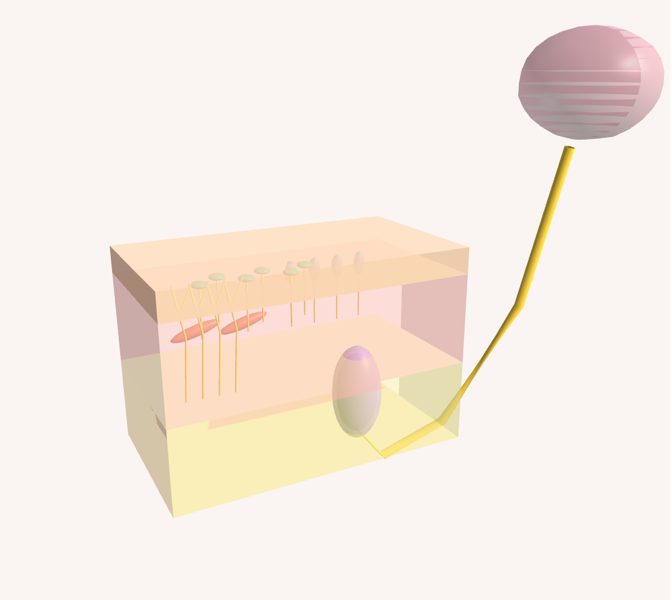
Touch is part of the somatosensory system. The skin has several types of receptors: Meissner's corpuscles (light touch), Merkel discs (sustained pressure,…
Explained for every age
For kids (7–11)
With touch you feel if something is soft like a teddy bear or rough like sandpaper, if it's cold or hot, if it vibrates or if it hurts. Your skin has lots of tiny sensors, and each type takes care of something different. Your fingertips and lips have loads of them, which is why they're so sensitive.
For teens (12–16)
Touch is part of the somatosensory system. The skin has several types of receptors: Meissner's corpuscles (light touch), Merkel discs (sustained pressure, shapes and edges), Pacinian corpuscles (vibration and deep pressure), Ruffini endings (skin stretch) and free nerve endings (pain, temperature and itch). Some only signal when something changes and then "get tired"; that's why you stop feeling your clothes a while after putting them on. The signals travel along nerves to the spinal cord and from there to the brain.
Pre-Med (17+)
Low-threshold cutaneous mechanoreceptors, innervated by Aβ fibers: slowly adapting type 1 (Merkel discs; shape and roughness, small receptive fields), slowly adapting type 2 (Ruffini; stretch, large fields), rapidly adapting type 1 (Meissner; flutter and slip, small fields) and rapidly adapting type 2 (Pacini; high-frequency vibration, large fields). Free nerve endings (Aδ and C fibers) mediate pain, temperature and itch, as well as crude touch. The density of SA1 and RA1 receptors is highest in the fingertips and lips, which is reflected in two-point discrimination (about 2–8 mm on the fingertip versus 30–40 mm on the back). Fine touch and vibration ascend via the dorsal column–medial lemniscus pathway; pain, temperature and crude touch via the anterolateral (spinothalamic) system.
What you can explore
Meissner's corpuscle (tactile corpuscle)Pacinian corpuscle (lamellar corpuscle)Merkel nerve ending (Merkel disc)Ruffini ending (bulbous corpuscle)Free nerve endingTouch pathways and sensory homunculus
Missions
- Your skin's sensors Explorer
- Five receptors, five jobs Discoverer
- Mechanoreceptors and ascending pathways Pre-Med