 rganauta
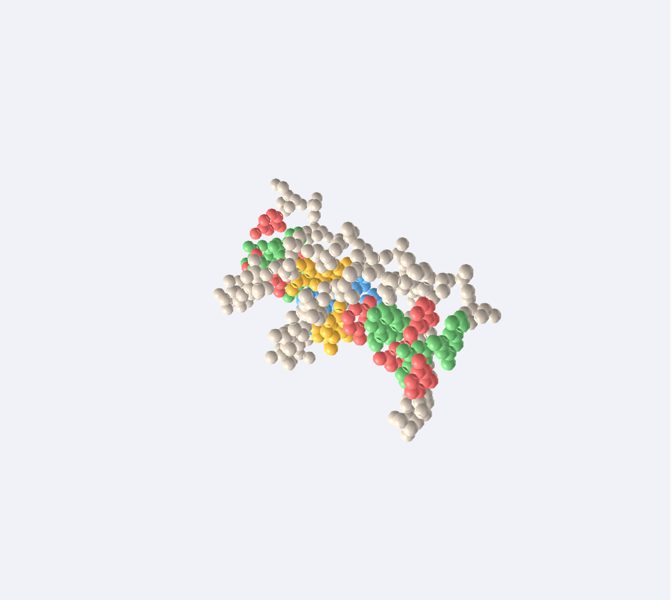
DNA in 3D
A double helix of two sugar-phosphate strands joined by base pairs: adenine with thymine (2 hydrogen bonds) and guanine with cytosine (3). It makes one…
Explained for every age
For kids (7–11)
DNA is your body's instruction book. It is a spiral staircase: the sides are the backbone and the steps are four letters (A, T, G and C) that always pair the same way: A with T and G with C. This is the real shape of a tiny piece of DNA.
For teens (12–16)
A double helix of two sugar-phosphate strands joined by base pairs: adenine with thymine (2 hydrogen bonds) and guanine with cytosine (3). It makes one full turn about every 10.5 pairs, roughly 3.4 nm. Your 46 chromosomes add up to about 2 meters of DNA per cell, with about 6 billion base pairs (about 3 billion inherited from each parent). What you see is a real 12-pair fragment measured with X-rays (PDB 1BNA).
Pre-Med (17+)
B-DNA: right-handed helix ≈ 2 nm in diameter, ≈ 10.5 bp per turn, major and minor grooves (protein binding sites), antiparallel 5'→3' strands. Watson-Crick base pairing; semiconservative replication (helicase, primase, DNA polymerase, Okazaki fragments, ligase); packaging into nucleosomes (histones) and chromatin. 1BNA: the Dickerson CGCGAATTCGCG dodecamer (Drew et al., 1981), the first B-DNA structure at atomic resolution.
What you can explore
Sugar-phosphate backboneAdenineThymineGuanineCytosineGenetics and heredityProtein synthesis
Missions
- The spiral staircase Explorer
- Base pairs Discoverer
- Replication and damage Pre-Med