 rganauta
Biomolecules: the carbon of life in 3D
Biomolecules are the molecules that make up living things. Some are inorganic, like water and mineral salts, and others are organic, built on carbon atoms…
Explained for every age
For kids (7–11)
Your whole body is made of tiny pieces called molecules. The ones that make up living things are called biomolecules, and almost all of them have a carbon skeleton, like building blocks that join together in a thousand ways. There are four big families: sugars, fats, proteins and nucleic acids. And they all live surrounded by lots of water!
For teens (12–16)
Biomolecules are the molecules that make up living things. Some are inorganic, like water and mineral salts, and others are organic, built on carbon atoms bonded to hydrogen, oxygen, nitrogen, phosphorus and sulfur. Organic ones are grouped into four families: carbohydrates, lipids, proteins and nucleic acids. Many are polymers, that is, chains of small repeated pieces (monomers): glucose forms starch, amino acids form proteins and nucleotides form DNA. In the nutrition zone you saw which foods contain them; here you will see what they are like inside.
Pre-Med (17+)
Living things are made mostly of C, H, O, N, P and S (CHNOPS); carbon accounts for approximately 45–50 % of dry biomass. Macromolecules (polysaccharides, proteins and nucleic acids) are assembled from monomers through condensation reactions, which release one water molecule per bond, and are broken down by hydrolysis, which consumes it. Lipids are not true polymers: they are defined by their low solubility in water rather than by a repeating unit. The properties of each biomolecule depend on its carbon skeleton and its functional groups (hydroxyl, carbonyl, carboxyl, amino, phosphate).
What you can explore
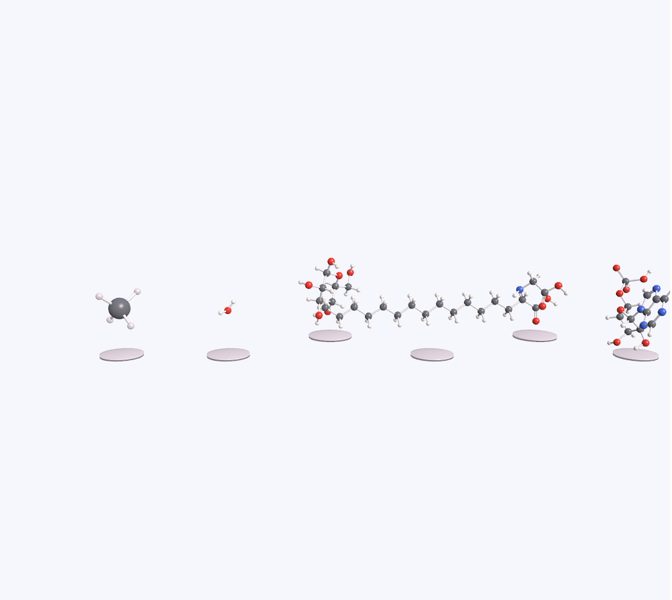
Carbon atomWater moleculeCarbohydrate moleculesLipid moleculesAmino acids and proteinsNucleotides
Missions
- The building blocks of life Explorer
- From monomers to polymers Discoverer
- Bonds that build life Pre-Med