 rganauta
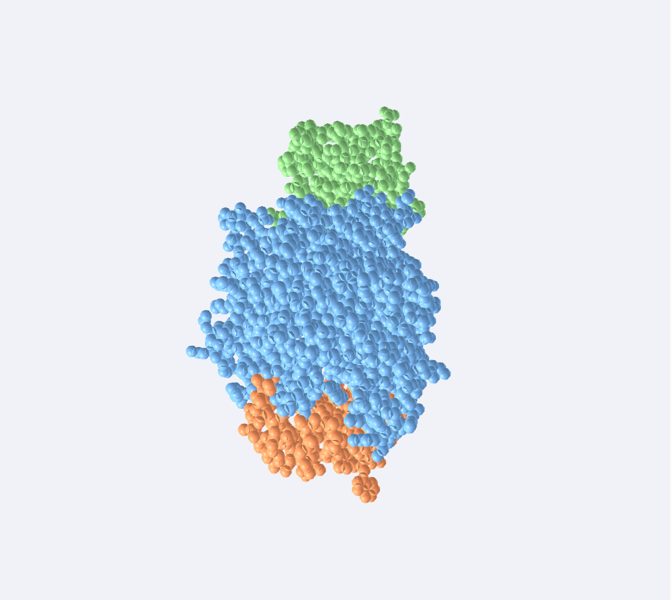
Amylase (real molecule) in 3D
Amylase is an enzyme: a protein that speeds up a chemical reaction without being used up. The salivary glands pour it into saliva, so starch digestion…
Explained for every age
For kids (7–11)
Amylase is a tiny tool in your saliva. It cuts the starch in bread, rice or potatoes into smaller sugars. That's why, if you chew a piece of bread for a while, it starts to taste a little sweet. What you see is a real amylase, atom by atom.
For teens (12–16)
Amylase is an enzyme: a protein that speeds up a chemical reaction without being used up. The salivary glands pour it into saliva, so starch digestion already begins in the mouth. It breaks long starch chains into short pieces, mainly maltose (two linked glucose molecules) and dextrins. When food reaches the stomach, the acid eventually switches it off; later, in the small intestine, amylase from the pancreas carries on the work. The model is human salivary amylase measured with X-rays (PDB 1SMD).
Pre-Med (17+)
α-Amylase (EC 3.2.1.1; formerly called ptyalin): endohydrolysis of α-1,4-glucosidic bonds in starch and glycogen, yielding maltose, maltotriose and limit dextrins (the α-1,6 bonds at branch points are cleaved by other enzymes). Glycoside hydrolase family 13 (GH13), double-displacement mechanism with retention of anomeric configuration. Salivary isoforms AMY1A/B/C and pancreatic AMY2A/B, at 1p21; AMY1 copy number varies between populations and is associated with starch-rich diets. It is a calcium metalloenzyme activated by chloride, with an optimal pH near 7. 1SMD: 496 residues, one Ca²⁺, one Cl⁻ and 170 waters, at 1.6 Å (Ramasubbu et al., 1996); three domains, A, B and C.
What you can explore
Domain A (catalytic domain)Domain BDomain CCalcium and chloride ions
Missions
- The bread that turns sweet Explorer
- An enzyme in your saliva Discoverer
- GH13: catalysis and clinical use Pre-Med