 rganauta
Organ of Corti (ear) in 3D
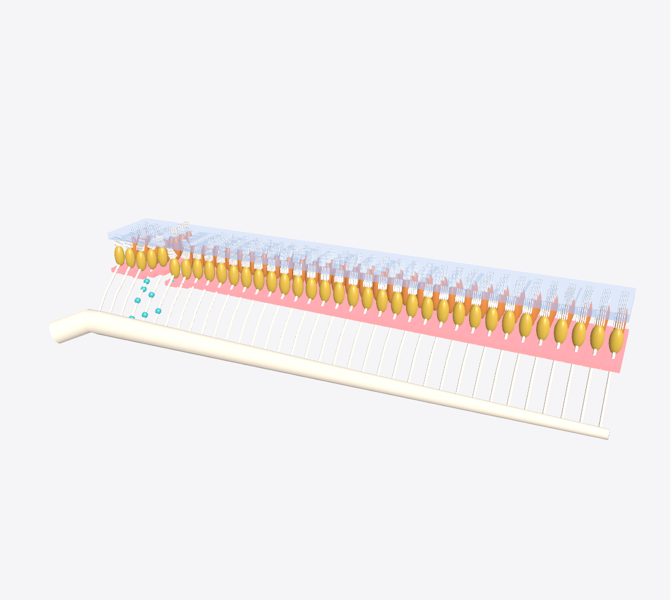
The organ of Corti is the receptor for hearing. It is inside the cochlea, resting on the basilar membrane. It has one row of inner hair cells and three…
Explained for every age
For kids (7–11)
This is the organ of Corti, inside the snail-shaped part of your ear. It is a pink strip full of cells with little white hairs on their heads. When a sound arrives, the strip moves like a wave, the little hairs bend, and the cells send a message to the brain through the gray cables.
For teens (12–16)
The organ of Corti is the receptor for hearing. It is inside the cochlea, resting on the basilar membrane. It has one row of inner hair cells and three rows of outer hair cells, with tufts of stereocilia. When sound makes the fluid in the cochlea vibrate, the basilar membrane forms a traveling wave; the stereocilia bend against the tectorial membrane, and the hair cells create a signal that goes to the brain through the cochlear nerve. Each area responds to a pitch: high pitches near the base and low pitches near the apex.
Pre-Med (17+)
Sensory epithelium of the scala media, between the basilar membrane and the tectorial membrane, bathed on its surface by K⁺-rich endolymph. It contains one row of inner hair cells and three rows of outer hair cells, supported by Deiters' cells and pillar cells. At birth there are on the order of 3,500 inner and 12,000 outer hair cells. The uncoiled cochlea measures about 33–34 mm and is tonotopically organized: the base, narrow and stiff, responds to high frequencies and the apex, wide and flexible, to low ones, within the human range of about 20 Hz to 20 kHz. The inner hair cells are the true receptors; the outer hair cells amplify through electromotility. The scene is a straight diagram, not coiled and not to scale.
What you can explore
Basilar membraneInner hair cellOuter hair cellStereociliaTectorial membraneCochlear nerve
Missions
- The sound wave Explorer
- Every pitch in its place Discoverer
- Cochlear amplifier and damage Pre-Med