 rganauta
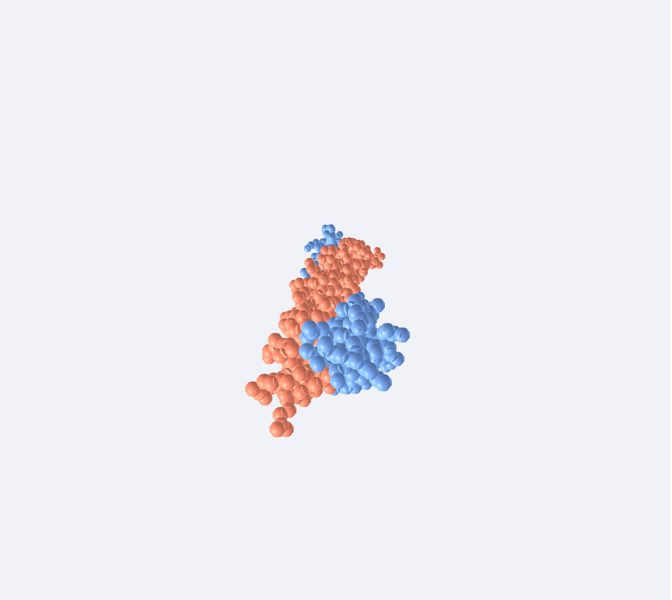
Keratin (real molecule) in 3D
Keratins are fibrous proteins that form intermediate filaments, part of the internal skeleton (cytoskeleton) of skin cells and other epithelia. They…
Explained for every age
For kids (7–11)
Keratin is the protein that makes your hair, your nails and the outer layer of your skin strong. It is made of threads that twist together in pairs, like two braided ropes. Here you see a real little piece of two skin keratins.
For teens (12–16)
Keratins are fibrous proteins that form intermediate filaments, part of the internal skeleton (cytoskeleton) of skin cells and other epithelia. They always work in pairs: a type I keratin twists around a type II keratin, forming a double spiral called a coiled coil. These pairs join together and form filaments about 10 nm thick that make cells resistant to bumps and rubbing. Hair and nails are dead cells filled with keratin. What you see is only a piece: segment 2B of keratins 14 and 5 (PDB 3TNU).
Pre-Med (17+)
Keratins: intermediate filament proteins (type I, acidic, and type II, neutral/basic); the human genome has 54 functional genes (28 type I, 26 type II), in clusters at 17q21 and 12q13. Common structure: a central rod domain of about 310 residues with helices 1A, 1B, 2A and 2B separated by linkers L1, L1-2 and L2, flanked by non-helical head and tail; the HIM and HTM motifs at the ends of the rod are highly conserved. Assembly: parallel type I–type II coiled-coil heterodimer → antiparallel tetramer → unit-length filament (ULF) → 10 nm filament. 3TNU: complex of the 2B regions of K14 (chain A) and K5 (chain B), at 3.0 Å (Lee et al., 2012); it is not the full protein.
What you can explore
Keratin 14 (type I)Keratin 5 (type II)
Missions
- Your skin's rope Explorer
- From pair to filament Discoverer
- K5/K14 and epidermolysis bullosa Pre-Med