 rganauta
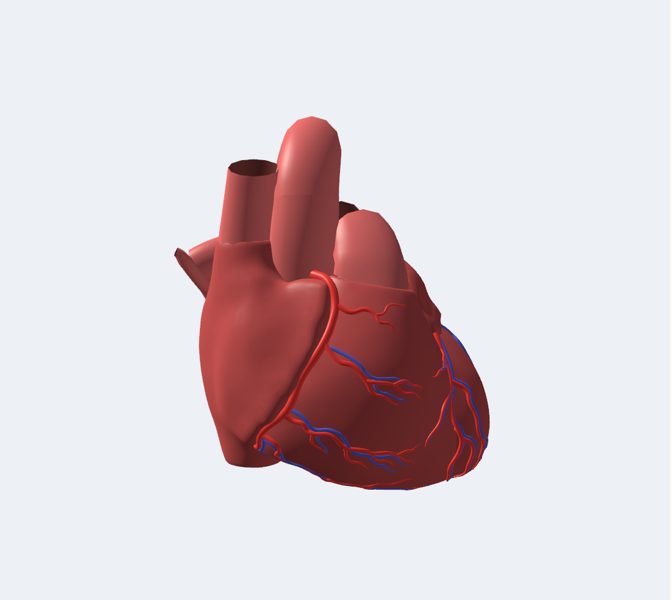
Heart in 3D
A hollow muscular organ with four chambers: two atria that receive blood and two ventricles that pump it out. The right side sends blood to the lungs and…
▶ Open it in 3D in your browserNothing to install · best on a computer
Explained for every age
For kids (7–11)
The heart is a pump the size of your fist. It beats about 100,000 times a day to push blood all through your body.
For teens (12–16)
A hollow muscular organ with four chambers: two atria that receive blood and two ventricles that pump it out. The right side sends blood to the lungs and the left side to the rest of the body.
Pre-Med (17+)
Hollow muscular organ of the middle mediastinum, resting on the diaphragm, with its apex pointing down, forward and to the left (5th intercostal space, midclavicular line). It weighs ≈ 250–350 g in adults. Its four chambers and four valves form two pumps in series: the right heart drives the low-pressure pulmonary circulation (≈ 25/10 mmHg) and the left heart the systemic circulation (≈ 120/80 mmHg). Three-layered wall (endocardium, myocardium and epicardium) inside the pericardial sac. Cardiac output = heart rate × stroke volume ≈ 70 bpm × 70 mL ≈ 5 L/min at rest, and it can rise 4- to 5-fold during exercise. The impulse arises in the sinus node and is modulated by the autonomic nervous system: sympathetic activity (β1 receptors) raises rate and contractility; the vagus (M2 receptors) slows the sinus node and the AV node.
What you can explore
Right atriumRight ventricleLeft atriumLeft ventricleTricuspid valveMitral valveAortic valvePulmonary valvePapillary musclesCoronary arteriesCardiac veinsCardiac cycleCardiac conduction systemCardiac action potentialElectrocardiogram (ECG)Pressure–volume loop
Missions
- What is happening to this artery? Explorer
- Detective: blocked arteries Discoverer
- From fatty streak to heart attack Pre-Med
- Feel your pulse Explorer
- Blood's journey Explorer
- Follow the blood Discoverer
- Systemic and pulmonary circulation Pre-Med
- The body's pump Explorer
- The double circuit Discoverer
- Clinical case: chest pain Pre-Med
- The residents of the blood Explorer
- Closing a wound Explorer
- Three steps to stop bleeding Discoverer
- Hemostasis and anticoagulation Pre-Med
- Read the ECG Pre-Med
- Clinical case: heart failure Pre-Med
- Draw the heart Discoverer
- Freehand coronaries Pre-Med
- The four rooms of the heart Explorer
- The path of the blood Discoverer
- Time trial: heart Pre-Med