 rganauta
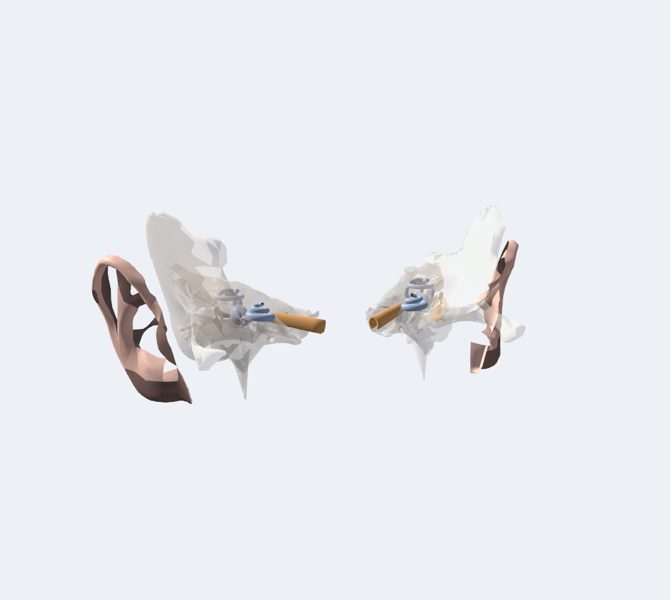
Ear in 3D
Outer ear (auricle and canal up to the eardrum), middle ear (eardrum and the malleus-incus-stapes chain, connected to the throat by the auditory tube) and…
Explained for every age
For kids (7–11)
The ear has three parts: the outer ear collects sound, in the middle three tiny bones pass it along and, deep inside, a snail shell full of fluid turns it into signals for the brain. That is also where your sense of balance is.
For teens (12–16)
Outer ear (auricle and canal up to the eardrum), middle ear (eardrum and the malleus-incus-stapes chain, connected to the throat by the auditory tube) and inner ear (cochlea for hearing and vestibule with three semicircular canals for balance). Sound vibrates the eardrum, the ossicles amplify it and the cochlea translates it by frequency.
Pre-Med (17+)
External: auricle, external acoustic meatus (2.5 cm, cerumen), tympanic membrane. Middle: tympanic cavity with malleus, incus and stapes (gain ≈ 20×), tensor tympani and stapedius muscles, Eustachian tube, mastoid. Internal: bony and membranous labyrinth; cochlea (about 2.5–2.75 turns, organ of Corti on the basilar membrane with tonotopy: high pitches at the base) and vestibular apparatus (utricle and saccule with maculae for linear acceleration; three semicircular canals with ampullary crests for angular acceleration). CN VIII.
What you can explore
Tympanic membraneAuditory tubeAuricleTympanic membrane and auditory tubeAuditory ossiclesInner ear
Missions
- The journey of sound Explorer
- Air, bone and fluid Discoverer
- Conductive or sensorineural Pre-Med