 rganauta
Cell in 3D
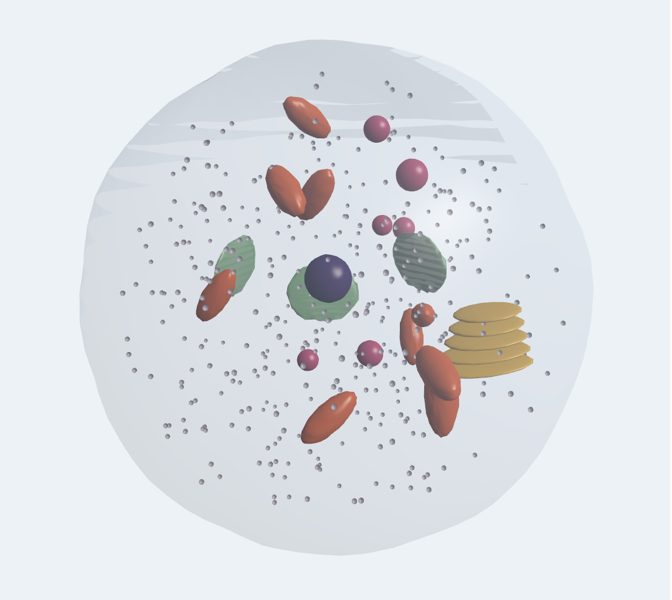
The basic unit of life. It has a membrane that separates it from the outside, a nucleus with the DNA and, in the cytoplasm, organelles that make proteins,…
▶ Open it in 3D in your browserNothing to install · best on a computer
Explained for every age
For kids (7–11)
Your body is made of trillions of cells, each one like a tiny city with its wall, its control center and its energy factories.
For teens (12–16)
The basic unit of life. It has a membrane that separates it from the outside, a nucleus with the DNA and, in the cytoplasm, organelles that make proteins, produce energy and recycle waste. Most cells are so small that they can only be seen under a microscope.
Pre-Med (17+)
Eukaryotic cell: plasma membrane (lipid bilayer with proteins), nucleus with a double envelope and chromatin, cytoplasm with membranous organelles (rough and smooth endoplasmic reticulum, Golgi apparatus, mitochondria, lysosomes, peroxisomes) and non-membranous ones (ribosomes, cytoskeleton, centrosome). About 30 trillion cells in an adult (≈ 36 trillion in men and 28 trillion in women), of about 200 types.
What you can explore
Cell membraneNucleusMitochondrionEndoplasmic reticulumGolgi apparatusLysosomeRibosomeReal cell (HeLa, FIB-SEM)Plant cell and photosynthesisMitosisBiomoleculesCellular energyMessenger moleculesHistory of the cell and science in ChileDiffusion and osmosisStem cells, cancer and bioethics
Missions
- A tiny city Explorer
- Organelles in action Discoverer
- Energy and signaling Pre-Med
- Clinical case: a disease inherited from the mother Pre-Med