 rganauta
Blood types in 3D
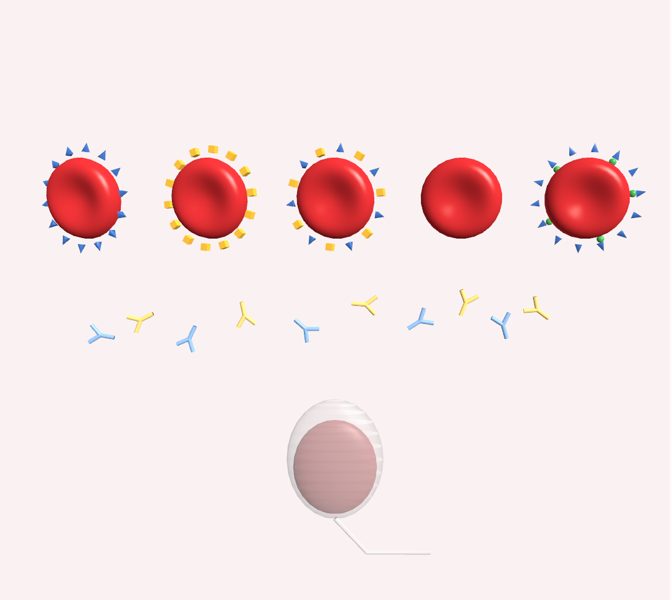
Your blood type depends on markers called antigens on the surface of your red blood cells, and on the antibodies floating in your plasma. The two most…
Explained for every age
For kids (7–11)
Not all blood is the same: each person has a blood type, like an invisible uniform worn by their red blood cells. Knowing your type helps doctors choose the right blood if someone ever needs it.
For teens (12–16)
Your blood type depends on markers called antigens on the surface of your red blood cells, and on the antibodies floating in your plasma. The two most important systems are ABO (types A, B, AB and O) and Rh (positive or negative), which makes 8 types in total. It matters most in transfusions: if a person receives blood from a type that is not compatible, their antibodies can attack the red blood cells they received and cause a serious reaction. That's why the blood type is always checked before a transfusion.
Pre-Med (17+)
A blood group is the classification of blood according to the presence or absence of inherited antigens on the red blood cell membrane (proteins, carbohydrates, glycoproteins or glycolipids). The International Society of Blood Transfusion (ISBT) recognizes dozens of systems, but ABO and Rh are the most clinically relevant. Karl Landsteiner described the ABO groups in 1901 when he observed that the serum of some people agglutinated the red cells of others; he received the Nobel Prize in 1930. ABO incompatibility can trigger a potentially fatal acute hemolytic transfusion reaction; RhD and other system incompatibilities matter in alloimmunization and in hemolytic disease of the fetus and newborn.
What you can explore
ABO antigensAnti-A and anti-B antibodiesBlood group OBlood group ABRh factor (RhD)Blood donation
Missions
- Blood labels Explorer
- Compatibility detectives Discoverer
- Transfusion immunohematology Pre-Med