 rganauta
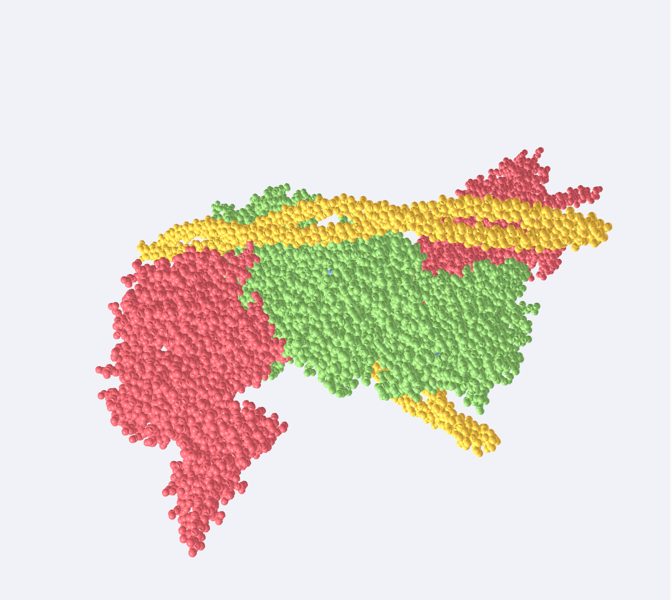
Actin and myosin (real molecule) in 3D
Actin forms thin filaments, and myosin has motor heads that hook onto them, forming cross-bridges. Each head pulls the filament and makes it slide: that…
Explained for every age
For kids (7–11)
Actin and myosin are the proteins that move your muscles. Myosin has heads that grab onto a thread of actin and pull it, again and again, using energy from ATP. This model shows their real shape, measured in great detail; the proteins are human, but from cells that are not muscle, and they work in a similar way.
For teens (12–16)
Actin forms thin filaments, and myosin has motor heads that hook onto them, forming cross-bridges. Each head pulls the filament and makes it slide: that is how a muscle shortens without the filaments changing length. What you see is a piece of human actin filament with two myosin heads and strands of tropomyosin, obtained by cryo-electron microscopy (PDB 5JLH). This myosin is not the muscle type but a 'non-muscle' type II myosin, which pulls on actin in other cells by a similar mechanism.
Pre-Med (17+)
Human cytoplasmic actomyosin complex solved by cryo-electron microscopy at 3.9 Å (von der Ecken et al., Nature, 2016). It contains five subunits of cytoplasmic γ-actin (ACTG1; chains A–E), each with ADP and Mg²⁺; two motor domains of non-muscle myosin 2C (MYH14; chains F–G); and four tropomyosin segments (TPM3; chains H–K). Non-muscle myosin II belongs to the same class as skeletal muscle myosin and is found in stress fibers and in the contractile ring of cytokinesis. The myosin heads in the model have no bound nucleotide, the situation corresponding to the rigor state of the cross-bridge cycle.
What you can explore
Actin filamentMyosin motor domainsTropomyosinADP and magnesium
Missions
- The muscle's oars Explorer
- The cross-bridge cycle Discoverer
- Actomyosin in 5JLH Pre-Med